
Coffee culture around the globe: Traditions, Rituals and Variations
Coffee is a beverage enjoyed around the world. While it may seem simple at first glance, the variations of beverages ranging from drip coffee to a flat white scratch the surface of how different cultures enjoy this delicious beverage.
Whether you are based in the Americas, Europe, or Asia, you may be surprised to learn that not only is coffee a bit different around the world, but many of the traditions surrounding how it is consumed vary dramatically.
Ethiopia
The common thinking is that Ethiopia is the birthplace of coffee. That early adopter status makes it the perfect place to highlight how coffee culture differs worldwide.
While many in the Western world, primarily if you are used to Starbucks, want our coffee as quickly as possible, Ethiopia’s coffee ceremony takes a different approach.
Drinking coffee is often a group activity in Ethiopia. Families and friends would gather to speak about news and events and even share some wisdom of the older generation with the younger ones. While the conversation is the final stage in the ceremony and may seem similar to other cultures, it doesn’t reflect the entirety of the ceremony.
It begins with the host roasting the green beans over hot charcoal. As the beans roast, the aromas fill the area and arouse the guests with the coming flavors. To ensure an even roast, a traditional menkeshkesh, a small pan with holes in the bottom that allow the smoke from the charcoal to come through, is used.
The beans are then cooled by hand using a straw fan. Once the beans have cooled, they are ground by hand with a mortar and pestle, usually finely.
A jebena is a clay pot with a broad base and a long spout that holds the brew. It’s filled with water and allowed to boil. The ground coffee is now added to the jebena and begins brewing.

Pouring coffee from a Jebena
The coffee is served in small cups called sini or cini with no handles. Pouring from the jebena requires a special skill: avoiding adding grounds to each cup. At the same time, the pour is from a height entirely above the cup to create a frothy layer on top. A good host will be skilled in pouring the coffee without grounds but with the perfect froth, aided by the long spout of the jebena. The pour is usually done without stopping until the cup is full.
The ceremony involves three rounds, with conversation during each. The first cup is served in a round called Abol, which has the strongest coffee. The grounds are reused for the second round, Tona, but now the flavor is more muted, and the conversations may reflect that, taking on a different tone. The final round, Bereka, reuses the grounds, so the coffee is the weakest. In this way, the fading of the flavor signals the end of the ceremony.
The entire ceremony often takes hours, and it is an intentionally slow and deliberate process that builds relationships. Coffee isn’t rushed or gulped down, as we may do in a morning cup to jump-start our day. Instead, the coffee and the face-to-face conversations, stories, and reflections with fellow guests are savored.
Italy
With espresso drinks’ vast popularity, it’s only fitting to discuss where they were born. Italy’s coffee shops are busy from morning to night, and espresso is often enjoyed standing at the bar while conversing. Like Ethiopia, the experience isn’t just a solo coffee consumption but a communal conversation over an espresso. Perfecting an espresso pull is the goal of baristas, and with coffee consumed throughout the day, they often have plenty of time to practice.
Of course, with espresso being created in Italy, when one orders a Caffè, it’s understood that it means an espresso. While coffee is consumed all day in Italy, never make the faux pas of drinking cappuccino in the afternoon. It’s a morning-only drink!
Turkey
Of course, many coffee connoisseurs know of the unique flavor of Turkish coffee. An old proverb suggests that coffee should be “black as hell, as strong as death and sweet of love”. The proverbs are likely as old as Turkey’s coffee culture, dating back to the Ottoman Empire.
Historically, coffeehouses or kahvehane were places where people gathered to discuss politics, even heated ones. The communal aspect is a striking contrast to the image of a hipster with a laptop drinking coffee alone in a Starbucks.

Turkish Cezve
The long copper handle pot called the Cezve is used for brewing. Finely ground coffee and some sugar are put in the pot and water and then brought to a boil. With the grounds unfiltered, Turkish coffee can have a gritty texture, and it often has very strong flavors.
France
Is there anything more quintessentially French than a Parisian cafe? These are not coffee shops where you rush in and grab a coffee. Instead, they are social gathering spots where quality is prioritized, even if it takes more time to prepare.
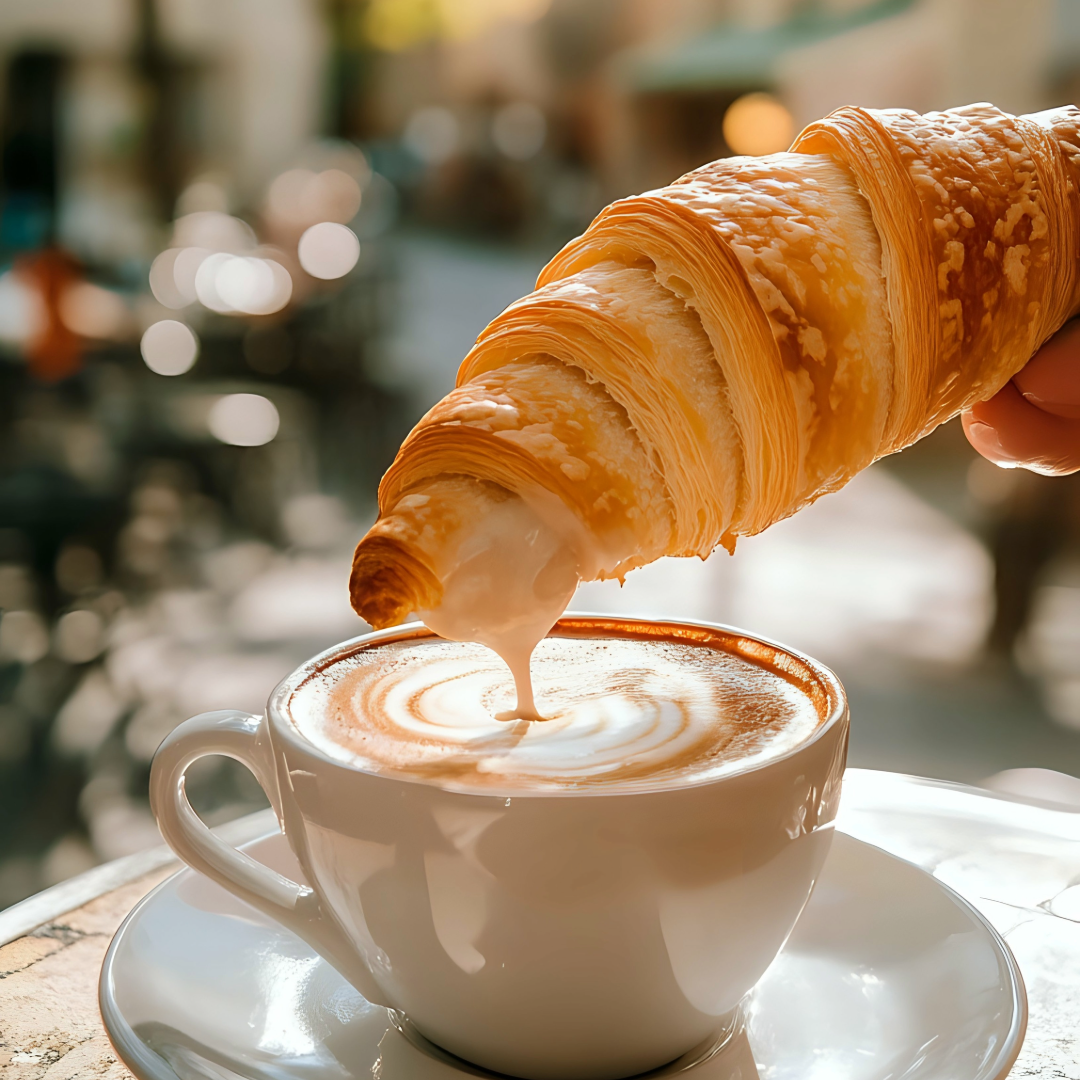
Café au lait with a croissant being dipped
Espresso tends to be the most popular type of drink in France. However, the French have contributed with the café au lait, which has gained popularity across their borders. Some may not realize that the café au lait is intended to be served in a cup with a wide brim… offering enough space to dunk a croissant.
Netherlands
While foreigners might think coffee shops in the Netherlands are the cliche drug dens where marijuana is served more than coffee, there are many more coffee-serving cafes throughout the country.
Coffee has a long history in the Netherlands. The Dutch East India Company (VOC) had trade routes around the world, including Indonesia, the home of Java, and a great source of coffee cultivation for the Netherlands, which was as far back as the 17th century.
If you visit cities like Amsterdam, you will see many areas with a central square surrounded by cafes with outdoor seating. Initially, coffee was a luxury, so the original cafes typically catered to the wealthy and had opulent furnishings.
By the 18th century, coffee had become a staple for everyone. The VOC continued to trade in coffee and helped develop more plantations in other parts of the world, such as Central and South America.

Dutch koffie with stroopwafel
Coffee is still a popular drink today. The Netherlands is a small country, and the major city of Amsterdam has less than 800K people. Yet, they still drink around 6.5 million cups of coffee per day. The Dutch love to drink their koffie throughout the day. It’s typically served black and with a koekje (cookie) or stroopwafel. Even in Dutch homes, visitors are asked if they’d like a lekkere kopje koffie (delicious cup of coffee) accompanied by a cookie natuurlijk (of course).
Cuba
The story of coffee in Cuba began in the mid-17th century. While coffee was initially imported, it was quickly realized that the climate was ideal for growing coffee locally. The first plantations in Cuba are on the UNESCO World Heritage list.
As a result, coffee has become ingrained in Cuban culture, and some might say it is part of the country’s identity. Outside the country, we might refer to the style as a Cafê Cubano, but it’s just known as typical espresso in Cuba.
Cuban coffee is enjoyed throughout the day. It’s typically served in espresso shots. Whenever someone has a visita (dropping in on neighbors or family), coffee is served while they gossip.
Almost every home in Cuba has a stovetop espresso maker, like a Moka Pot. The espresso is typically served with sugar already mixed in.
Japan
Japan may not be the first country you think of for coffee. While tea has a rich history in Japan, coffee has grown in popularity. If you love cold brew coffee, its creation can be directly linked to Kyoto, Japan, in the 17th century.
The overwhelming theme in Japanese coffeehouses is precision. The baristas’ meticulous attention joins artistry and presentation to detail in preparing each cup. Traditional teahouses are a significant influence on modern coffee houses in Japan. Beverages are often joined with delicious desserts. Ambiance frequently leans toward a space for slower-paced experiences and conversations among patrons. There are some grab-and-go-style coffee houses as well, which show the influence of American-style “fast food.”
United States
Many of our readers may be based in the United States, so this may not surprise them. Coffee culture here has changed dramatically over the past 30 years. While coffee has long been a popular beverage, it was often seen as an accompaniment to a meal, which was usually breakfast. Diner restaurants would have a pot of drip coffee ready to serve patrons. While it wasn’t the best cup of coffee, it was cheap and helped wake you up.
While many denigrate Starbucks, it did spawn the dedicated coffee shop trend that has grown over the past 40 years. Going to a specialty coffee shop has become mainstream in the United States. This has changed the emphasis toward better quality coffee and more options than drip coffee. Espresso-based drinks soared in popularity, along with coffee prices, as demand grew. Where coffee could once be bought for around $0.50/cup in the 1980s, it’s regularly around $5/cup today.
A common sight in many U.S. coffee shops is a person with a laptop using the free Wi-Fi to work. Some may sit there for hours, drinking coffee with headphones to isolate themselves from the other patrons. This social experience differs from that in many different countries.
But, while the isolated laptop user may be typical earlier in the day on weekdays, many coffee shops will have live music, poetry readings, or other happenings in the evenings or on weekends, changing the shop’s character to more of a social or entertainment focus. This dichotomy of solitary laptop users and shared experience with live music seems to be a unique tension not found in many other places worldwide.
Conclusion
Coffee truly is an international beverage. While it is produced in a few countries, leading to concerns about exploitation, consumption is far more widespread. Cultural norms around drinking coffee are as varied as the number of coffee drinks.
Some common traits, such as the communal social dimension, may have been diffused as it spread from its Ethiopian origins thousands of years ago. But even with the evolution of the ceremonies surrounding coffee consumption around the globe, the love of the beverage remains. If you find yourself traveling to another place in the world, while the experience may differ from the one you have at home, you’ll be sure to find coffee at the core, ensuring some semblance of familiarity even in an unfamiliar land.